Jong H. Chung wrote an article,
Integrating Technology in the Classroom, that focuses on the historical background of bringing technology into the classroom and the motivation behind it. He also provides examples of how to use technology in the classroom, as well as his concerns and recommendations for doing so successfully. I will touch on all of these topics as I review his article.
In the early part of the 20th century, visual aids such as films and pictures became more prevalent in presenting information to students in the public school setting. As far back as 1913, people began to realize that technology would start to become a bigger part of education. Thomas Edison even claimed that books would soon become obsolete, as the information could be taught through other mediums (Chung, 1). While he was right, the forms in which they thought would take over were incorrect. Many believed that radio would become a large part of education but it had little impact. It seemed as if people would become very excited about the various mediums through which they could teach, but in the end each at little impact and the excitement wore off. Computers and the internet seem to be the only exception as throughout the past decade their prevalence has grown and become an integral part of many classrooms.

The motivation for adopting technology in the classroom comes from 3 sectors: nonprofit organizations, commerce, and education. The nonprofit organizations have been providing guidelines to promote technology proficiency and private industry has been using technology to train their employees, as well as to educate them further. The largest push, though, comes from
education. Nearly all educators find benefit in using technology in the classroom, but many disagree on the way that it should be utilized. The two main ideas for using technology in the classroom are incorporating it into traditional lecture style teaching and using it in a more constructivist approach. Constructivism is, "a model of learning that asserts that knowledge is not passively received but actively created inside the mind of every learner" (National Research Council, 2002). This approach focuses mainly on student-centered learning, where the student explores to learn as opposed to the teacher just telling him or her the information. This kind of classroom presents problems in a real-world context which could be beneficial to them even when they leave school.
Chung provides some examples of using technology in the classroom that include
interactive whiteboards, classroom management software, student response systems, blogs, Wiki, and even more. Each of these technologies can keep students actively engaged in class and feel independent and work on becoming technologically proficient. In one of my previous blogs I reviewed an award-winning teacher's
blog and it is a great example of how technology can be used successfully even in a first grade classroom.
While integrating technology into the classroom is a wonderful thing, Chung presents some concerns as well. One of his concerns is unwilling teachers. There may be teachers out there that are not willing to put in the time and effort necessary to use technology successfully in their classroom. They may also be unwilling to change the way that they teach. Another concern he has is that teachers will think that students will become too dependent on the internet and not think about problems deeply enough. Though there are concerns, Chung gives his recommendations on how to successfully incorporate technology into the classroom.

His first recommendation is to make sure that the change is gradual. I think that this is really important to keep in mind if you are new to using technology in the classroom. It is less likely to be successful if you try to jump all in at once and then confidence will be lost and your students will not be able to benefit from technology. Another one of his recommendations is to "Use technology to help students to visualize, simulate, solve real-world problems, collaborate, research, and design whenever possible"(Chung, 7). I think that it is so crucial to incorporate technology in a variety of ways so that students can see the different ways in which they can utilize it. By doing this they can see that technology is important and helpful in many different settings. The last recommendation I want to talk about its educating the internet users on copyright laws and plagiarism. If students are going to be using the internet and technology they should be able to do so in the correct way. They should be completely aware of the laws in place to protect people's work on the internet and teaching this directly is an important part of bringing technology into the classroom.
Chung, J. H. (2007). Integrating technology in the classroom. Retrieved from http://www.usma.edu/cfe/
Literature/Chung_07.pdf
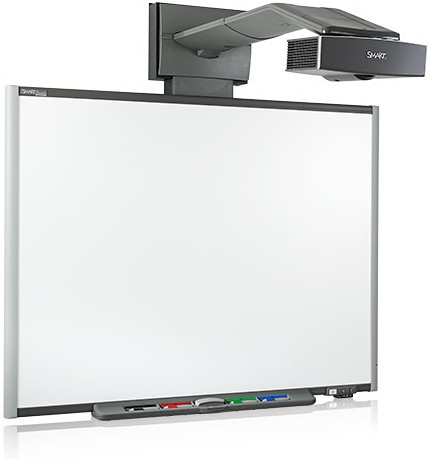 Interactive whiteboards are wonderful
instructional tools that bring technology into the classroom. These boards
allow teachers to improve student engagement and achievement in a variety of
ways. With this board it is possible to highlight, annotate, drag and drop
information, import pictures, use multimedia content, provide feedback,
complete shared readings, use student response systems, and so much more!
Interactive whiteboards are wonderful
instructional tools that bring technology into the classroom. These boards
allow teachers to improve student engagement and achievement in a variety of
ways. With this board it is possible to highlight, annotate, drag and drop
information, import pictures, use multimedia content, provide feedback,
complete shared readings, use student response systems, and so much more! The
interactive whiteboard has features associated with it that can improve student
learning even more. One that is statistically linked to achievement is studentresponse systems. These systems are great for formative assessments and knowing
where your students are at in their learning. It also promotes student participation,
which improves learning. A twenty-six-percentile
gain in achievement was noted when using these response systems in an effective
way!
The
interactive whiteboard has features associated with it that can improve student
learning even more. One that is statistically linked to achievement is studentresponse systems. These systems are great for formative assessments and knowing
where your students are at in their learning. It also promotes student participation,
which improves learning. A twenty-six-percentile
gain in achievement was noted when using these response systems in an effective
way!


